The 6b6t 1,000-Player Claim Deserves More Scrutiny
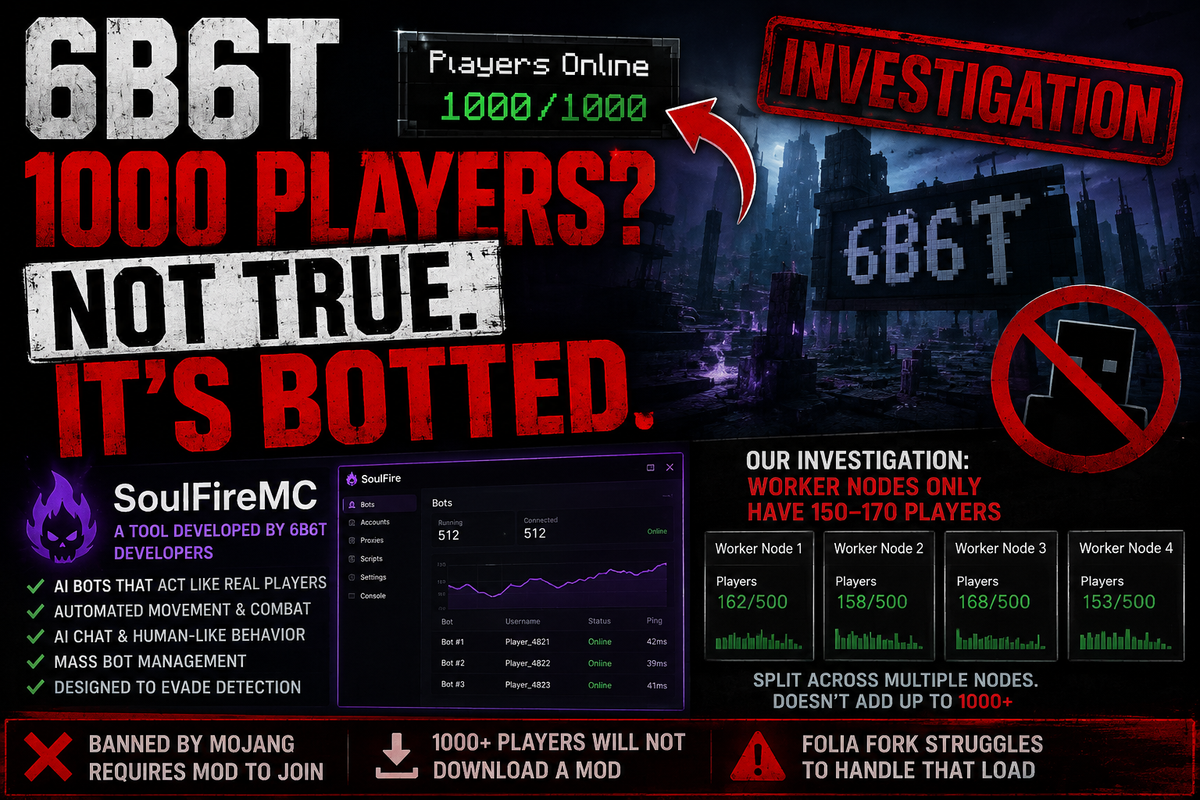
For years, player count has been one of the easiest ways for Minecraft servers to demonstrate popularity. When a server suddenly claims hundreds—or even 1,000+ players online at the same time—the natural assumption is that those are 1,000 genuine people actively playing.
Back in 2022 we covered that Qbasty was exposed for Botting/DDOSING 8b8t.me to shut it down which you can view here:
But when it comes to 6b6t, there are reasons to question exactly what its advertised player count represents.
This is not a claim that every player displayed on 6b6t is a bot. Rather, the question is whether the numbers being presented should automatically be interpreted as 1,000 genuine human players.
6b6t Has Already Advertised the 1,000-Player Goal
6b6t itself states that it reached an all-time record of 580 players online simultaneously on June 1, 2025. The server subsequently announced that supporting 1,000 players without a queue was going to become a reality.
6b6t's current website advertises support for up to 1,000 simultaneous players. It also currently states that it has 200+ players daily.
The distinction between supporting 1,000 players and actually having 1,000 genuine players online simultaneously is important.
Those are two completely different claims.
The Mod Requirement Creates a Major Barrier
According to 6b6t's own website, Mojang banned the server and players are instructed to download AnarchyMod before connecting.
That means a player who discovers 6b6t cannot simply enter an IP address and join with an ordinary client.
They need to:
- Find the server.
- Decide they actually want to play it.
- Download the required software.
- Install the appropriate Minecraft/Fabric setup.
- Launch the modified client.
- Connect to the server.
For a specialized anarchy server, getting 1,000 genuine humans online simultaneously under those circumstances would be an extraordinary achievement.
It isn't impossible.
But it raises a reasonable question:
Where are all of those players coming from?
The Server Architecture Raises Another Question
This is where the investigation becomes particularly interesting.
6b6t does not simply run one conventional Minecraft server process containing the entire player population.
6b6t has publicly explained that it runs a heavily modified fork of Folia and that its software was specifically developed to scale toward 1,000 players. In its own technical explanation, 6b6t said its machine at the time was theoretically capable of approximately 500–600 players and that a larger machine would be used to reach 1,000.
Third-party documentation of 6b6t's current architecture describes its custom Folia-derived software as distributing the world across multiple servers. The documentation identifies separate server processes for different portions of the world, rather than treating the entire world as one traditional Minecraft server instance.
That distinction matters when examining the player counter.
Our Investigation
During our investigation, we examined the individual worker/server nodes that make up 6b6t's infrastructure.
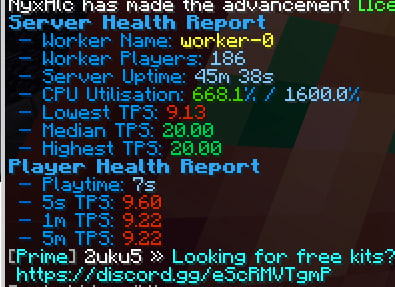
The screenshots show individual worker nodes reporting approximately 150–170 connected players.
This is important because the public-facing player count can give the impression that a single server instance is handling 1,000 players.
That is not what the underlying architecture appears to be doing.
Instead, players are distributed across multiple worker nodes/regions.
If the individual worker nodes are each reporting only around 150–170 players, the question becomes:
How exactly is the advertised 1,000-player figure being calculated?
The screenshots should therefore be viewed as evidence of what the individual nodes reported at the time of our investigation—not, by themselves, definitive proof that the overall 1,000-player figure is fabricated.
However, they do create a significant discrepancy that deserves an explanation.
The Numbers Don't Add Up the Way You Would Expect
If the server claims 1,000 players online, but the individual worker nodes visible during an investigation are reporting populations in the 150–170 range, simply looking at one node does not establish that 1,000 players exist.
At minimum, all of the relevant worker nodes would need to be accounted for.
For example, if there are six worker processes averaging 160 players, that would be approximately:
160 × 6 = 960 players
That could potentially explain a number close to 1,000.
But if the actual number of active workers, their populations, or the way their counters are aggregated does not support that total, then the public-facing number requires further explanation.
This is why screenshots of the individual workers are important.
They allow the community to independently examine the underlying infrastructure instead of relying exclusively on the number displayed by the public server list.
Why This Matters
A distributed architecture isn't inherently suspicious.
In fact, distributing players across multiple servers is exactly how a project like 6b6t can attempt to scale beyond the limitations of a conventional Minecraft server.
6b6t itself has openly discussed this engineering challenge and its goal of supporting more than 1,000 players.
The issue is transparency.
If 6b6t advertises:
1,000 players online
then users should reasonably be able to understand how that number is produced.
Is it:
- The total number of players across every worker?
- The number connected to the proxy?
- A cached value?
- A combination of Java and Bedrock?
- Players connected to lobby infrastructure?
- Something else?
Without knowing how the number is calculated, the headline number is difficult to independently verify.
The SoulFire Connection Is Especially Interesting
Another important piece of technology to consider is SoulFire, an open-source Minecraft bot framework.
SoulFire is designed to create Minecraft bots that behave much more like actual clients than traditional simple bot programs.
Its feature set includes automation, reconnection, movement, combat, chat, account management, proxy support and AI functionality.
The important part isn't simply that bots exist.
Minecraft botting has existed for years.
The important development is that modern bots can be made substantially more convincing than the stereotypical “AFK bot standing in spawn.”
SoulFire's AI functionality can allow bots to interact with chat using an LLM, while its automation and scripting capabilities allow considerably more complex behavior.
That means a server population should not automatically be assumed to consist entirely of humans simply because the accounts appear to be moving or communicating.
Does SoulFire Prove 6b6t Is Botting?
No.
This distinction is extremely important.
The existence of SoulFire does not prove that 6b6t is currently using SoulFire to inflate its player count.
What it proves is that the technology exists and that sophisticated Minecraft bots are technically capable of behaving in ways that can resemble genuine players.
Therefore, if a server claims an unusually high player count, independent verification becomes important.
A screenshot showing “1,000 players online” is not sufficient evidence by itself.
The Folia Question
There is also a technical question surrounding how 6b6t can sustain such a large population.
It would be inaccurate to simply claim:
“Folia cannot handle 1,000 players.”
6b6t has specifically developed a heavily modified Folia-based system for scalability, and the server has publicly stated that its custom software is intended to support 1,000 players.
The more appropriate question is:
Can 6b6t's specific implementation handle 1,000 genuine, active players while maintaining acceptable performance?
A Minecraft server isn't just processing 1,000 network connections.
It may simultaneously have to process:
- Thousands of entities
- Chunk loading
- Player movement
- Block updates
- Inventories
- Redstone
- Commands
- Chat
- World saves
- Plugin logic
- Network traffic
- Entity AI
- Player interactions
And anarchy servers can generate particularly chaotic workloads because players aren't restricted by normal gameplay rules.
Therefore, proving 1,000 players should involve more than showing a player counter.
What Would Actually Prove 1,000 Real Players?
If 6b6t wants its 1,000-player milestone to be independently credible, several measurements would be useful.
Server performance
- TPS during the claimed peak
- MSPT during the claimed peak
- CPU utilization
- RAM usage
- Network bandwidth
- Chunk activity
- Entity counts
- Player distribution across workers
Player authenticity
- Number of authenticated accounts
- Average session duration
- Join/leave patterns
- Player activity
- Number of players actually interacting with the world
- Distribution of connections across infrastructure
None of these individually proves that every account belongs to a human.
Together, however, they would provide substantially more confidence than a single number displayed on a website.
The Evidence We Have So Far
There are several facts that should be separated from speculation.
Confirmed: 6b6t previously documented a legitimate 580-player concurrent record.
Confirmed: 6b6t has publicly stated that it uses a heavily modified Folia fork and has been developing technology intended to support 1,000 players.
Confirmed: 6b6t currently advertises a 1,000-player capacity.
Confirmed: 6b6t currently requires players to download its AnarchyMod according to its website.
Observed during our investigation: Individual worker nodes shown in our screenshots reported approximately 150–170 players.
Not proven by these observations alone: That 6b6t is definitely using bots to inflate its player count.
That final distinction matters.
The goal should not be to manufacture evidence for a predetermined conclusion.
The goal should be to ask a simple question:
Does the publicly advertised player count accurately represent the number of genuine human players simultaneously playing 6b6t?
Right now, there are enough unusual details surrounding the infrastructure and player count to justify asking that question.
The Bottom Line
6b6t has clearly invested significant engineering effort into solving the problem of large-scale Minecraft servers.
Its own developers have openly discussed the goal of reaching 1,000 players, and its custom infrastructure is specifically designed around scalability.
But a server being capable of supporting 1,000 players does not automatically mean that 1,000 genuine humans are currently playing.
The worker-node screenshots provide an interesting piece of evidence that should be examined alongside the public player counter.
Combined with the existence of sophisticated Minecraft botting frameworks such as SoulFire, the mandatory client modification required to join 6b6t, and the unusual distributed architecture, the 1,000-player claim deserves independent scrutiny.
Until the underlying numbers can be independently verified, the responsible conclusion isn't:
“6b6t definitely bots its player count.”
It's:
“There are enough unanswered questions that the 1,000-player figure should not automatically be treated as proof of 1,000 genuine human players.”
And that's a question that 6b6t itself could settle with transparency.